How Does ISO Affect Flash Photography? – Easy Explanation
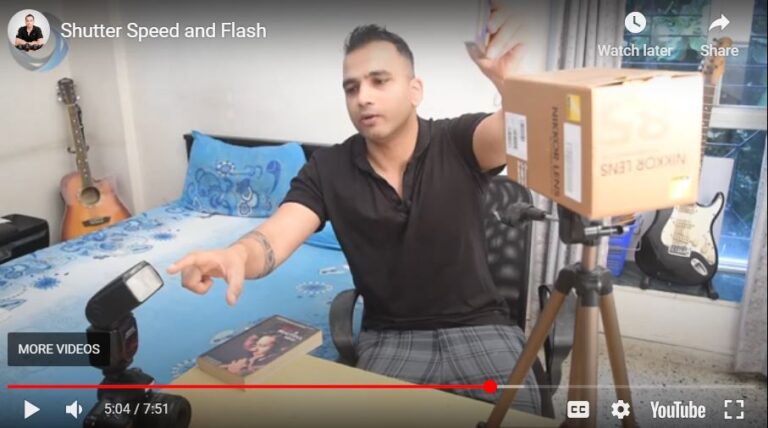
ISO plays a crucial role in flash photography, impacting brightness, noise, and overall image quality. In this video, we’ll break it down in a simple way—how ISO interacts with flash, when to raise or lower it, and how it affects ambient and flash-exposed areas differently. Whether you’re shooting indoors or outdoors, understanding ISO will help you get the perfect balance of light. Stay tuned for an easy explanation that will improve your flash photography!
This video is from our Off-Camera Flash Photography Course.
Video Summary:
This tutorial explains the effect of ISO in flash photography. It confirms that ISO works the same for both ambient (natural) light and flash exposure. Increasing the ISO amplifies the sensor’s sensitivity, making both the ambient-lit areas and flash-lit areas in a photo brighter. Decreasing the ISO makes both areas darker. This differs from adjusting flash power, which only affects the flash-lit areas. The video demonstrates this principle with a series of photos where only the ISO changes, clearly showing the entire image (background and subject) getting uniformly brighter or darker.
Timestamps:
0:05 – Introduces the topic: how ISO works with flash.
0:11 – Reviews that ISO controls the sensor’s sensitivity to light, affecting overall exposure and noise.
1:27 – Explains the core principle: ISO affects both ambient (natural) light exposure and flash exposure equally, as the light from both sources is amplified by the sensor.
2:43 – Clarifies that changing ISO is similar to but not the same as changing flash power. Flash power only affects flash-lit areas, while ISO changes the brightness of the entire image.
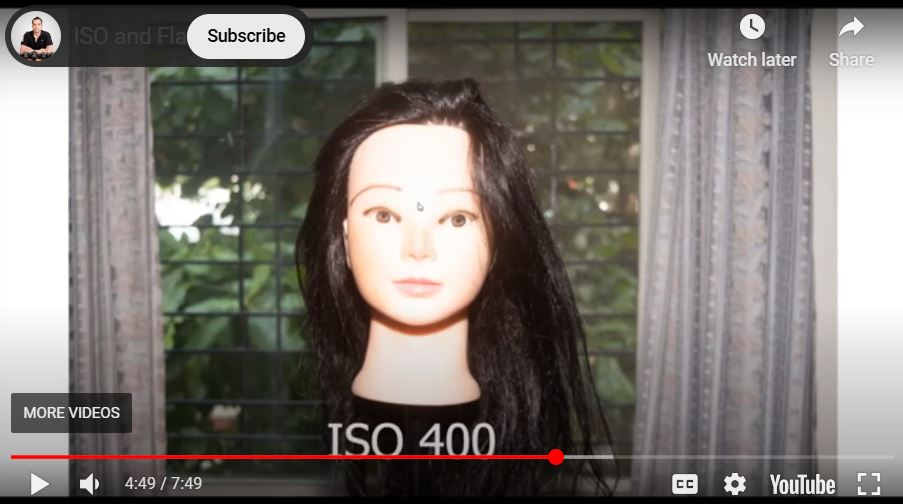
3:09 – Practical demonstration using a series of images with a flash-lit subject and ambient-lit background.
* 3:56 – ISO 100: Baseline exposure.
* 4:08 – ISO 200: The entire image (subject and background) becomes brighter.
* 4:49 – ISO 400: Image brightens further.
* 4:55 – ISO 800, 1600, 3200: Demonstrates progressive brightening of both light sources, leading to overexposure.
5:14 – Defines a “stop of light” in terms of ISO (e.g., doubling the ISO from 100 to 200 is a one-stop increase).
6:00 – Reiterates the key distinction: Adjusting ISO changes both flash and ambient exposure, while adjusting flash power only changes the flash exposure.
7:10 – Briefly notes that in studio photography (with negligible ambient light), changing ISO has an effect similar to changing flash output, but this is a special case.