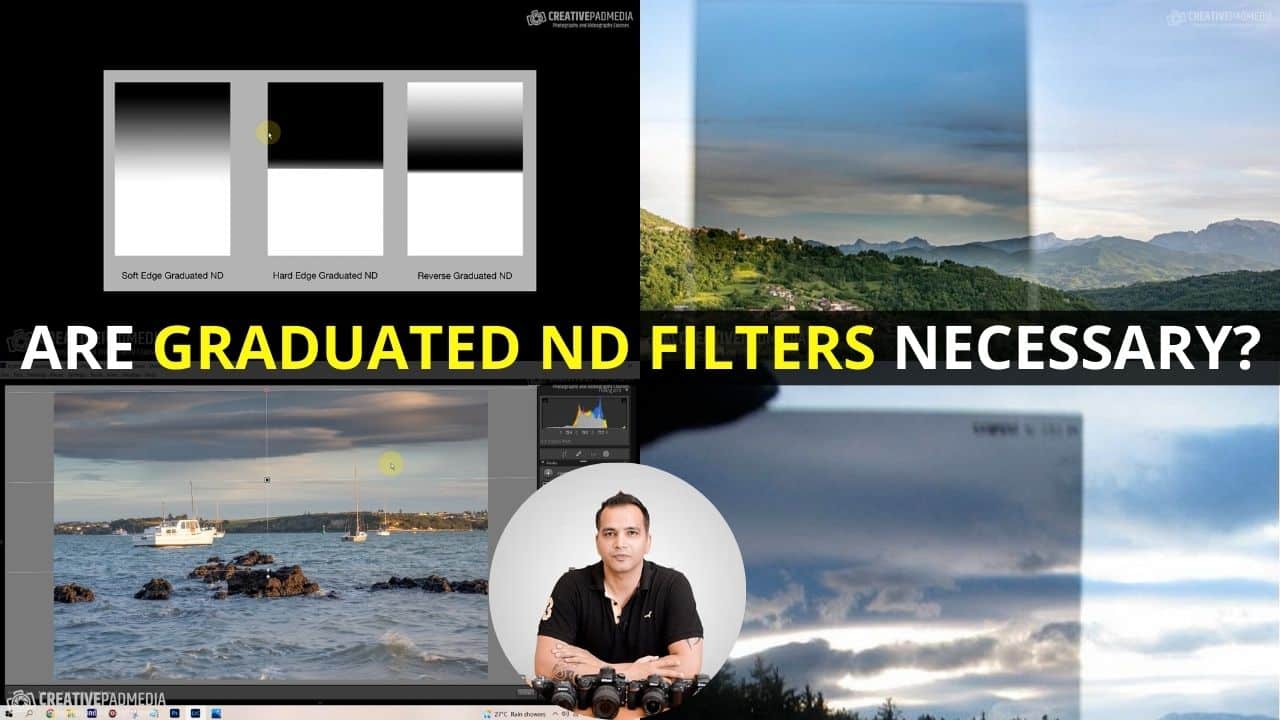
Are Graduated ND Filters Necessary? Do You Need Them?
In this video we will be having a discussion about a question often asked by beginner landscape photographers – Are Graduated ND Filters Necessary? Do I Need Them?
We will discuss various things like, how to use graduated ND filters, different types of filters and their pros and cons.
We will also be seeing how their effect can be replicated in multiple alternative ways, including using a digital graduated filter in an editing software like Adobe Lightroom. Here’s the video:
Video Summary
This video from Creative Pad Media explores the role of Graduated Neutral Density (GND) filters in landscape photography and whether they remain a necessary tool in the digital age.
Key Highlights:
- What is a GND Filter?: Unlike a standard ND filter, a GND filter has a gradient—it is dark at the top and transparent at the bottom. It is primarily used to prevent overexposing the sky while maintaining a well-exposed foreground in high-contrast scenes [00:35].
- Digital Replication: The creator demonstrates that the effect of a physical GND filter can be easily and often more effectively replicated in editing software like Lightroom using the Masking and Linear Gradient tools [04:12].
- Advantages of Physical Filters: Some photographers still prefer physical GND filters to get the shot right “in-camera,” which can save time in post-processing and provide a sense of old-school professional satisfaction [09:12].
- Disadvantages: High-quality GND filters are expensive (around $150). They are also physically cumbersome to use, requiring precise positioning and potentially multiple strengths (stops) for different lighting conditions [12:37].
- Determining Filter Strength: To choose the right filter, you calculate the “stop” difference between the ideal shutter speed for the foreground and the ideal shutter speed for the sky [18:17].
- Types of GND Filters:
- Final Verdict: For beginners, the creator recommends prioritizing Polarizers and standard ND filters over GND filters, as the latter’s effects are the easiest to mimic through digital editing or HDR photography [23:28].
Important Links
This video is from our Landscape Photography Course, which has 30 videos and 5 hours of content. You can access the full course on Udemy by using the link below: